A manufacturing company consumes 12,000 units of a specific component annually. The cost per unit is $50. The ordering cost is $100 per order, and the annual carrying cost is estimated at 12% of the average inventory value.
Task: Calculate the EOQ and the Total Variable Cost (excluding material cost).
Solution:
Given,
Annual Demand (D) = 12000 Units Ordering cost (S) = $100 Unit cost (C) = $50 Holding Cost (H) : 12% of Average Inventory Value ( Cost per unit) = 0.12 * 50 = $6 per unit/year
EOQ CALCULATIONS
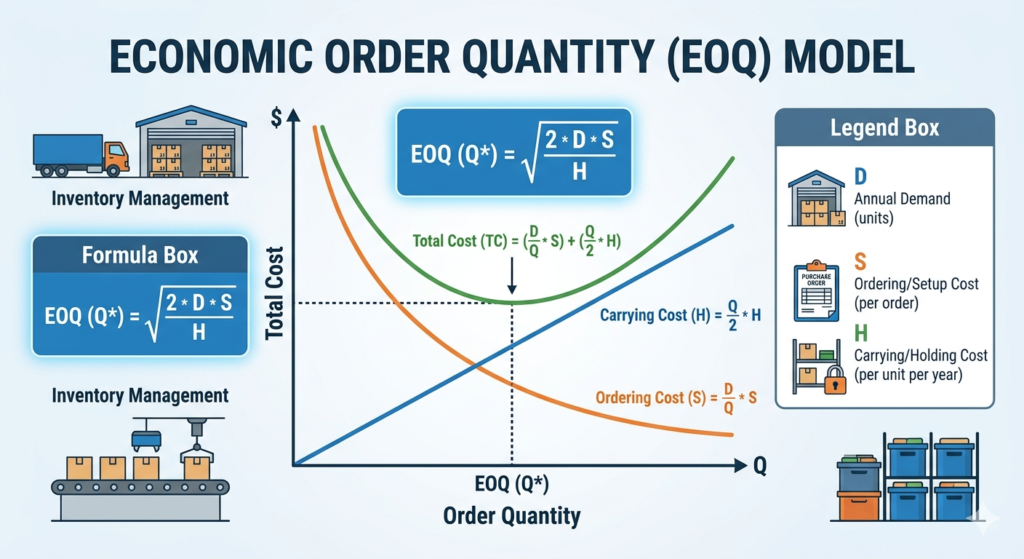
EOQ = √((2✕D✕S)/H) = √((2✕12000✕100/6) = √(400,000) ≍ 632.46 units
A retailer currently orders 2,500 units of a product four times a year. The annual demand is 10,000 units. The cost to place an order is $100, and the holding cost is $5 per unit per year.
Task: Determine how much the retailer could save annually by switching to the EOQ model.
Solution:
Given,
Annual Demand (D) = 10000 Units Ordering cost (S) = $100 Holding cost (H) = $5
If D = 5,000 units/year, S = $49, i = 20%. Find the best order quantity:
0 – 999 units: $5.00
1,000 – 1,999 units: $4.80
2,000 units and above: $4.75
Solution:

Calculating EOQ at Cost per unit @ $4.75

Holding Cost 		= 20% of Cost per unit
			= 0.20* $4.75
			= 0.95

EOQ = √((2✕D✕S)/H) = √((2✕5000✕49/0.95) ≍ 718.18 Units

Since 718 < 2,000, we must check the price break at Q = 2,000

Calculating EOQ at Cost per unit @ $4.80

Holding Cost 		= 20% of Cost per unit
			= 0.20* $4.80
			= 0.96

EOQ = √((2✕D✕S)/H) = √((2✕5000✕49/0.96) ≍ 714.43 Units

Since 714 < 1,000, we must check the price break at Q = 1000

Now, Calculating Total Cost at Q= 1000 units

Total Cost 	=(D/Q✕S) +(Q/2)✕H +D✕Cost per unit
		=(50001000✕49) +(1000/2)✕0.96+5000✕4.8
		= 245 +480 + 24000
		= $ 24,725

Now, Calculating Total Cost at Q= 2000 units

Total Cost 	=(D/Q)✕S) +(Q/2)✕H +D ✕ Cost per unit
		=((5000/2000))✕49) +(2000/2)✕0.95+5000✕4.75
		= 122.5+950 + 23750
		= $ 24,822.50

Since the Total Cost @ 2000 units is more, the optimal order quantity is 1000 units.
A factory produces its own parts. Annual demand is 10,000 units. The machine produces 20,000 units per year. Setup cost is $200 and holding cost is $2/unit/year. Task: Calculate the EBQ (EPQ) and the maximum inventory level.
Solution
Given,
Annual Demand (D) = 10,000 Units Ordering cost (S) = $200 Holding cost (H) = $2 Production Rate (P) = 20,000 units
For EBQ,
EBQ =√(2✕D✕S)/(H✕(1-D/P)) =√((2✕10000✕200)/(2✕(1-10000/20000)) = √((400000/(2✕0.5)) = 2,000 units